Four ways to develop software today. Which fits your project?

Every client who comes to us with a project eventually asks the same thing: "How much will it cost and how fast can you do it?" But the answer depends on a question almost nobody asks: How do you actually want to build it?
At Koala, we sat down and mapped out four distinct approaches to software development that exist in practice today. These are not marketing categories. They are real ways of working, each with its own strengths and its own ceiling. None of them is wrong. It just depends on what you need.
In our internal framework, we work with four models: vibecoding, classic development, AI-boosted development, and agentic systems. Each sits in a different place when it comes to quality, maintainability, speed, and cost.
Vibecoding
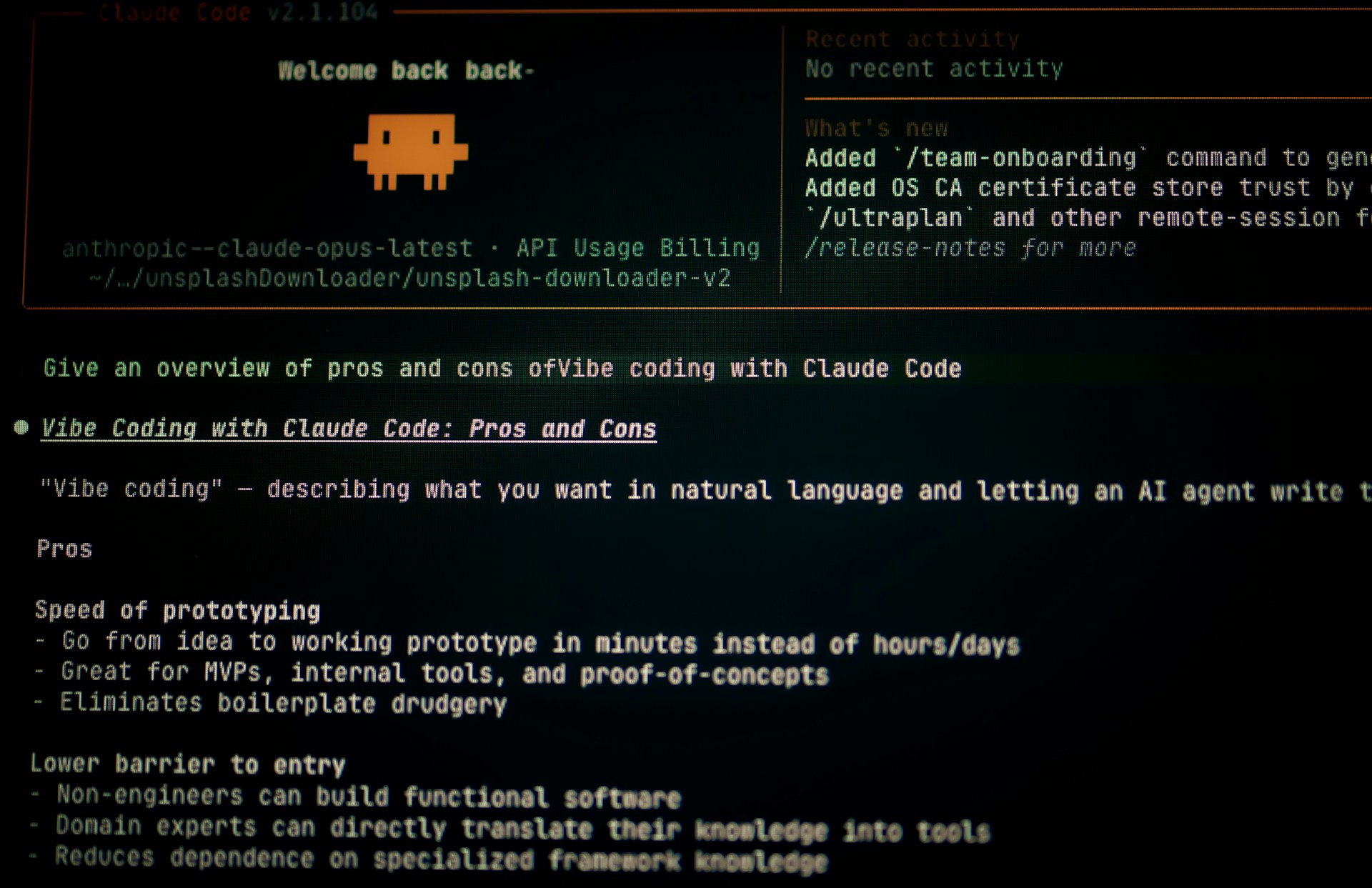
Vibecoding is the fastest and cheapest option, but it comes with lower quality and lower maintainability. Its main advantage is simple: you validate an idea very quickly, get a first working version, and can start collecting feedback right away.
This model makes the most sense when you have not fully committed to building yet, or when you are looking for investors. It works well for MVPs, internal tool experiments, early prototypes, proof-of-concept builds, or any situation where speed of learning matters more than technical precision.
The problems start when a quick experiment turns into a long-term product. What was fast at the beginning tends to slow down over time, because technical debt accumulates, edge cases multiply, and every new change becomes harder than the last.
In other words: vibecoding is not a bad choice at Koala, as long as you understand that its job is not to build the final house but to quickly put up a working model. For some companies, it is exactly the right starting point.
Classic Development
Classic development is the model that has historically emphasized architecture, clean solutions, testability, and long-term maintenance. In practice, though, we no longer recommend it as a default.
It still has its place where one specific requirement rules above all else: source code and sensitive data must not leave the company under any circumstances. This typically applies to heavily regulated core systems, internal platforms, or enterprise software where company policy simply does not allow code to pass through third-party AI model APIs.
Classic development is no longer automatically "better." It is more of a necessity when security and full code isolation are the top priority. If you are not sure how critical these factors are for your situation, that is what our product managers are there for. They will go through your processes with you before anything starts and honestly assess whether this slower approach still makes sense for you.
AI-Boosted Development
AI-boosted development is what we see as the middle path between speed and structure. Its main advantage is that the team uses AI as an accelerator and support layer without giving up technical decision-making. This makes it possible to speed up routine work, structural planning, parts of the code, or drafting options without the project falling apart the moment bigger changes arrive.
This tends to be a smart choice for companies that want to move delivery forward but are not willing to sacrifice long-term maintainability. It suits most modern products that need to stay current, keep evolving, and still make economic sense.
The challenge is discipline and process. AI does not guarantee quality on its own, and without strong guidance a team can simply produce mistakes, inconsistencies, and spaghetti code faster than before. Nobody will understand it a few months down the line. That is why having well-defined workflow, clear review mechanisms, and firm guardrails is absolutely essential. It is also why every development team at Koala has a senior tech lead overseeing the work.
Agentic Systems
An agentic system is not built for an immediate sprint. It is built for efficiency that grows over time.
It makes the most sense where there is a sufficient level of repeatability, clear rules, significant volume of work, and a longer time horizon. The more a project repeats similar tasks, decision patterns, or process steps, the better the chances that an agentic approach will return its initial investment.
It is also the most demanding model upfront. You need to account not just for the higher cost of the solution itself, but also for additional expenses on licenses, infrastructure, and team seniority. This kind of setup does not run on junior developers.
That is precisely why agentic systems are not a universal answer to everything. They are a powerful approach for the right type of project, but an unnecessarily heavy caliber for a product that is still figuring out its basic market fit.
How to Choose
The right question is not "which model is best" but "which model is best right now." If you need to test an idea quickly, vibecoding probably makes sense. If you are building a critical system meant to last for years, classic development is a more natural fit. If you want a reasonable balance between efficiency and structure, AI-boosted development is the right match. If you are building a long-term scalable operation with repeatable workflows, an agentic system may be the right path.
In practice, it is rarely about picking just one model. Mature projects often move between them. They start with fast validation, move into stabilization, and later add automation or an agentic layer where it finally makes economic sense.
That is, in our view, the most practical way to think about modern software development. Not looking for an ideology, but choosing the model that fits the current state of the product, the ambition of the company, and what the software is actually supposed to deliver for the business.
.webp)